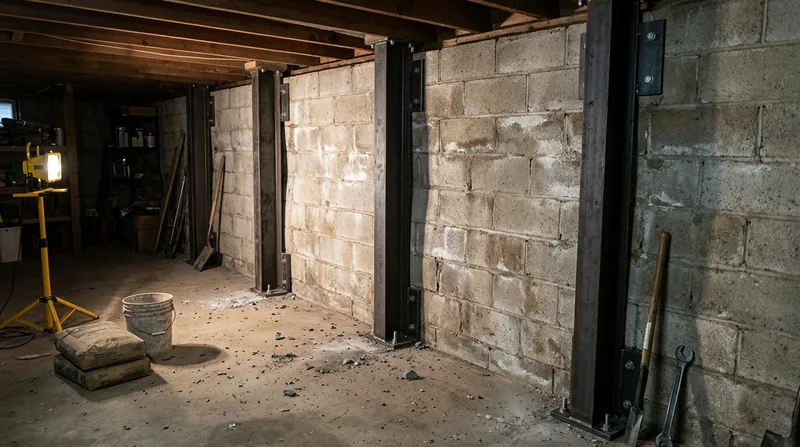



Bowing Wall Repair in Ames: When Clay and Frost Push Back
If you own an older home in Old Town or Campustown, you already know the look: a block or stone foundation wall that has started to lean inward, with a horizontal crack running along the mortar joints and a white chalky bloom of efflorescence near the floor line. That is not cosmetic. In Ames, the flat Des Moines lobe leaves us with glacial till clay loam that drains slowly, holds spring water near the surface, and pushes hard against basement walls through every freeze-thaw cycle. We perform Bowing Wall Repair in Ames for exactly this condition: stabilizing the wall before the movement gets worse and the floor joists above start to feel it. Whether your wall is in a 1920s brick foundation near the ISU campus or a 1970s block basement on the north side, the fix depends on how far the wall has moved and what is pressing on it. Start with a free basement inspection so we can measure the bow and read the pressure behind the wall.
Why Bowing Walls Are Common in Ames and What Drives Them
Ames sits on flat ground with heavy clay that soaks up snowmelt in March and spring rain in April and May, then releases it slowly against your foundation. The water table rises, hydrostatic pressure builds behind the wall, and the footing drain that was supposed to relieve it is often clogged or was never installed. Older block walls in the east and north neighborhoods were laid with soft mortar that freeze-thaw cycles open up over decades. Newer poured walls in Somerset and the north side are stronger, but they still bow when the clay stays saturated and the drain tile cannot keep up.
- Horizontal cracks in the middle third of the wall usually mean soil pressure, not settling.
- Walls that lean inward at the top are often tied to frost heave and poor grading around the foundation.
- Efflorescence and damp patches near the floor line point to water moving through the wall, not just condensation.
- Sticking doors and windows above the basement often follow a wall that has started to move.
All of these are measurable, and the measurement is what tells us whether carbon fiber straps will hold the wall or whether the job calls for steel I-beams or wall anchors.
Key info: We see the worst bowing on 1950s and 1960s block basements in the older east neighborhoods of Ames, where the original footing drain is clay tile and has been silted shut for decades. That is a drainage problem pressing on a structural wall, and both have to be addressed.
For the official record on structural permits in Ames, the city's building department is the authority to check before any wall stabilization work begins: City of Ames Building Division.
How We Approach Bowing Wall Repair in Ames
We start by measuring the bow with a plumb line and a string across the wall, then we look at what is behind it. The repair has to match the pressure, not just the crack. A wall that has moved half an inch gets a different answer than one that has moved two inches and is pulling the floor above with it. We also check the interior perimeter drain and sump setup, because a structural repair on a wall that stays wet will not hold.
- We inspect and measure the wall, note crack widths, and check the footing drain and sump basin.
- We identify whether the movement is active or has stopped, which changes the anchor or strap layout.
- We install carbon fiber straps, steel I-beams, or wall anchors depending on the bow and the wall material.
- We address the water source with drainage work so the pressure behind the wall is relieved, not just resisted.
- We document the before and after measurements so you can see the wall is stabilized.
A repair that ignores the water is a repair you will repeat, and we say so plainly on the estimate.
Key info: On a split-level in Huxley last spring, the block wall had bowed about an inch and a half after a wet March. Carbon fiber straps across the wall plus a cleared footing drain held it, and the homeowner avoided a full excavation. On a 1920s stone foundation in Old Town, the same bow needed steel I-beams because the mortar had lost too much strength for straps alone.
If the water is the main problem and the wall has only minor movement, the better first step is often interior drain tile to take the pressure off before we stabilize.
Bowing Wall Repair Methods We Use
The method follows the severity of the movement and the wall material. Here is how the four main approaches compare on Ames homes.
| Approach | Description | Best for |
|---|---|---|
| Carbon fiber straps | Straps epoxied to the wall from floor to sill, spanning the bow and holding the wall in place. | Moderate bow on block or poured walls with sound mortar. |
| Steel I-beams | Vertical steel beams anchored to the floor and the joists above, pressing the wall back or holding it. | Larger movement on older stone or brick foundations. |
| Wall anchors | Anchor plates set in the yard, tied through the wall to interior plates that pull the wall back over time. | Walls that have bowed outward or where interior space is tight. |
| Drainage correction | Clearing or replacing the footing drain and correcting grading so water stops pressing on the wall. | Walls with active water and early movement. |
Most Ames jobs combine a structural method with drainage correction, because the clay will keep pushing until the water has somewhere to go.
Bowing Wall Repair Cost in Ames: What to Expect
Pricing for bowing wall repair depends on how far the wall has moved, what it is made of, and how much drainage work is needed alongside the structural repair. A single wall with a moderate bow and sound mortar is a different job from a stone foundation that needs steel I-beams and a new footing drain. As a starting point, minor stabilization work begins at From $600, and the figure climbs with the number of straps or beams, wall length, and access.
Get two or three estimates and ask each contractor what they measured and why they chose that method. A quote that does not mention the bow measurement or the drainage behind the wall is a quote you should question. Our full pricing overview lays out how the numbers are built.
Key info: A homeowner in Kelley got three quotes for a bowed block wall. Two priced carbon fiber straps without checking the footing drain, which was clogged. The third included drainage correction, and that is the one that held through the next spring thaw.
Hiring a Bowing Wall Repair Contractor Near Ames
Bowing wall repair is structural work, and the contractor you hire should be able to explain what is pressing on the wall and how the repair resists it. Ask for proof of licensing and insurance, and ask whether the company carries general liability and workers' compensation. Get at least two or three written estimates, and ask for references from jobs in Ames or the surrounding towns. Confirm who pulls the permit, because structural foundation repair commonly requires one and the rules vary by jurisdiction. HOA requirements can also affect exterior work and anchor placement, so check before the crew arrives.
Reach out through our contact page to set up a free inspection.
If the wall is bowing and the basement is wet, the two problems are connected. Call (515) 203-8702 and we will tell you plainly whether you need structural stabilization, drainage work, or both.
Bowing Wall Repair in Ames: Pricing Guide
| Service | Price | Details |
|---|---|---|
| Carbon fiber strap installation | Starting at $600 | Covers a single strap on a moderate bow; wall length and strap count move the price. |
| Steel I-beam stabilization | Starting at $1,200 | Includes beam set, anchoring, and floor connection; number of beams and wall height drive cost. |
| Wall anchor system | On estimate | Needs an on-site look because anchor depth, soil, and yard access vary by property. |
| Drainage correction alongside repair | On estimate | Priced after inspection of the footing drain and grading; scope depends on what is clogged or missing. |
| Travel | Included | In Ames and surrounding areas, no separate call-out or mileage fee. |
| Estimate | Free | Response within 24h at (515) 203-8702, no obligation to book. |
Indicative pricing, the exact cost depends on square footage, finish, and site access. Free personalized estimate within 24h at (515) 203-8702.


